
How Can Musicians Build Sustainable Creative Habits?
Last Updated: October 25, 2026
Quick Summary
Sustainable creative habits for musicians prioritize consistency over intensity, treating rest as creative fuel rather than a break from work. Building practices that fit your actual life, typically 20-45 minutes, 3-4 days per week, creates the rhythm needed to maintain a long-term creative career without burnout.
- Practice 20-45 minutes on 3-4 days per week, not longer sessions you'll skip
- Schedule practice at your peak energy time and treat it like a non-negotiable meeting
- Learn one new skill per quarter and collaborate with other musicians to prevent staleness
- Measure consistency and energy levels, not perfection or hours practiced
Table of Contents
- Why Sustainable Creative Habits Matter for Musicians Over 40
- Building Good Practice Habits for Musicians: A Step-by-Step Foundation
- Designing Your Music Practice Schedule That Fits Your Life
- How to Develop Musical Creativity Without Burning Out
- Musician Burnout Prevention: Boundaries, Wellness, and Long-Term Thinking
- Avoiding Perfectionism and Setting Realistic Goals
- Measuring Progress Without Encouraging Overwork
- Start Your Sustainable Creative Habit Plan Today
- Frequently Asked Questions
Why Sustainable Creative Habits Matter for Musicians Over 40
Building sustainable creative habits is the difference between a career that lasts and one that burns out.
Sustainable creative habits aren't about pushing harder.
The musicians we work with discover something surprising: slowing down actually speeds up their creative work.
This isn't theory. Musicians who shift to sustainable creative habits stop waiting for inspiration and start building it into their routine.
Building Good Practice Habits for Musicians: A Step-by-Step Foundation
The foundation of sustainable creative habits starts with one truth: consistency beats intensity. A 30-minute practice session you actually do is worth more than a two-hour session you skip because life got in the way.
Start with a Realistic Music Practice Schedule
The biggest mistake musicians make is designing a schedule for the person they want to be, not the person they are right now. If you have a full-time job, family commitments, or physical limitations, a four-hour daily practice routine will fail.
Start smaller. Ask yourself: What's the minimum practice time you can commit to five days a week? Not someday. Right now.
For most musicians over 40, this lands between 20 and 45 minutes. That's your baseline. Here's how to build it:
- Identify your peak energy window. When during the day do you have the most mental clarity and physical energy? Morning, afternoon, or evening? Schedule practice then.
- Pick the same time every day. Your brain builds habits through repetition. Consistency matters more than duration.
- Start with 3-4 days per week. Not five. Not seven. Three or four sessions you actually complete beat seven sessions you half-do.
Create a Pre-Practice Warm-Up Ritual
Your body and mind need a transition into creative work. A warm-up ritual tells your nervous system: "We're shifting gears now."
This doesn't need to be complicated. A five-minute ritual works:
- Physical warm-up: Gentle stretching, neck rolls, or hand mobility work. Two minutes.
- Mental transition: A few deep breaths or a brief meditation. One to two minutes.
- Instrument warm-up: Play scales, familiar passages, or warm-up exercises. Two to three minutes.
The ritual stays the same every time. Your body learns to expect it. Over time, you'll notice you settle into focus faster.
Watch out: Skipping the warm-up to "save time" usually backfires. You end up spending more time getting focused, or you practice inefficiently and feel frustrated.
Designing Your Music Practice Schedule That Fits Your Life
A music practice schedule only works if it fits your actual life, not some idealized version of it.
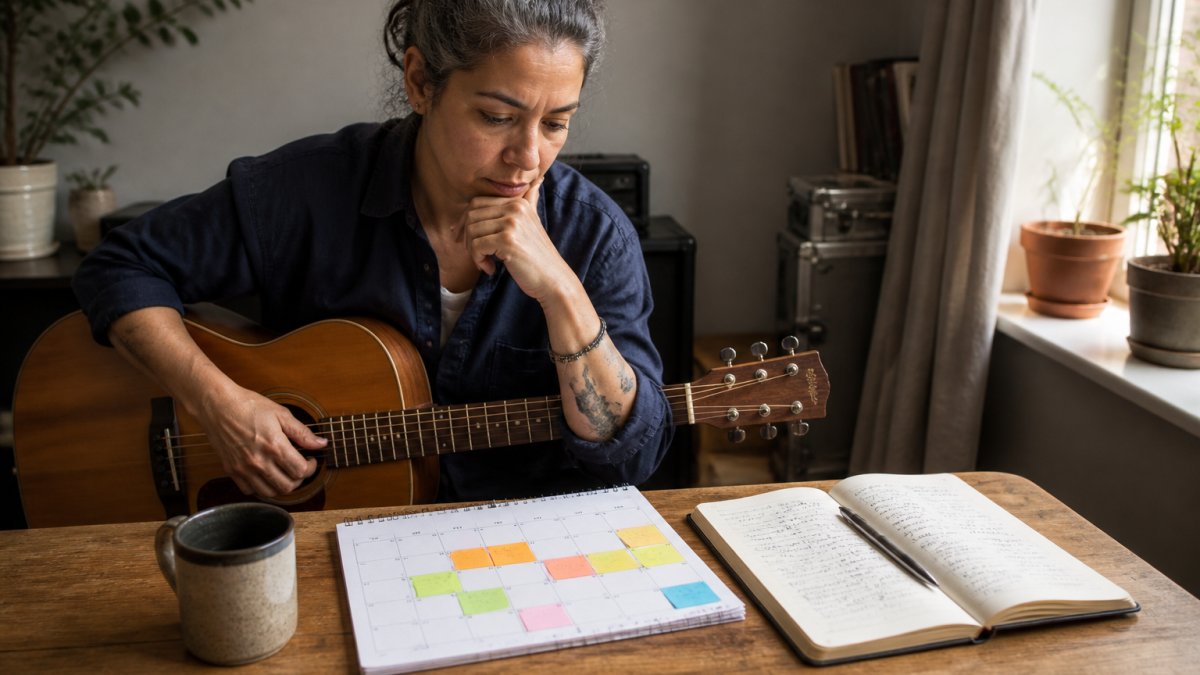
Start by mapping your week. Look at your calendar for the next month.
Many musicians find that early morning works best. The house is quiet. Distractions haven't accumulated yet.
Here's a practical framework:
Practice Element |
Time Needed |
Frequency |
Notes |
|---|---|---|---|
Warm-up ritual |
5 minutes |
Before each session |
Stretching + breathing + instrument warm-up |
Core practice |
20-45 minutes |
3-4 days/week |
Focused work on specific skills or songs |
Exploration time |
15-20 minutes |
1-2 days/week |
Improvisation, new material, joy-based playing |
Full rest days |
N/A |
2-3 days/week |
Complete break from practice |
The key is balance. Too much practice intensity leads to burnout. Too many rest days breaks momentum.
Build flexibility into your schedule. Some weeks, life demands more.
How to Develop Musical Creativity Without Burning Out
Burnout happens when you separate creative work from rest and recovery. You push, push, push until the tank is empty. Then you wonder why nothing feels good anymore.
Sustainable creative habits flip this. They treat rest as part of the creative process, not a break from it.
Rest and Recovery as Creative Fuel
Rest isn't laziness. It's where your brain consolidates what you've learned (Memory, Sleep and Dreaming: Experiencing Consolidation). It's where new ideas surface. It's where your body repairs the wear of practice.
Many musicians over 40 discover that their best ideas come during rest, not during focused practice. A walk. A shower. A day off. That's when the subconscious does its work.
Build rest into your creative habit:
- Take at least one full day off per week. No practice. No thinking about practice. Complete rest.
- Include active recovery. Gentle movement like walking, yoga, or stretching on your lighter days.
- Sleep is non-negotiable. Seven to eight hours matters more than an extra practice session.
Seeking Inspiration and Learning New Skills
Burnout also happens when you stop growing. You play the same material, the same way, until it feels stale. That's when you lose motivation.
Building inspiration into your routine prevents this. It keeps your creative work fresh.
Here's how:
The Rockstar's Blueprint eBook and eWorkbook bundle →
- Listen actively. Spend time listening to music that moves you. Not as background. Focused listening. What catches your ear? Why?
- Learn one new skill per quarter. A different technique. A new genre. A piece that challenges you. Something that feels slightly uncomfortable.
- Collaborate or jam with others. Playing with different musicians exposes you to new ideas and reminds you why you started.
The goal isn't to become an expert in everything. It's to stay curious. Curiosity is the antidote to burnout.
Musician Burnout Prevention: Boundaries, Wellness, and Long-Term Thinking
Burnout doesn't happen overnight. It builds slowly when you don't have boundaries, when wellness takes a back seat, and when you lose sight of why you're doing this.
Set Financial and Workload Boundaries
Many musicians over 40 face a specific pressure: the need to make money from their art, or the guilt of not doing so.
Sustainable creative habits require boundaries.
Start with these questions:
- How many gigs or projects can you realistically handle per month while still having time for personal creative work?
- What's the minimum income you need from music to make it feel worthwhile?
- What types of work energize you? What types drain you?
Once you know the answers, protect them. Say no to work that doesn't fit. Raise your rates so fewer projects generate the same income.
This isn't selfish. It's the only way to sustain a creative career long-term.
Integrate Plant-Based Fuel, Movement, and Nervous System Support
Your body directly impacts your creative work. When you're depleted, your creativity suffers. When you're energized, ideas flow.
Many musicians over 40 neglect physical wellness because they're focused on the music. But your instrument is your body. You wouldn't neglect your guitar or your voice, don't neglect the system that powers them.
Here's what matters:
- Fuel your body well. Plant-based nutrition provides sustained energy without the crashes. You don't need to be vegan, focus on whole foods that keep your energy steady.
- Move regularly. Walking, yoga, swimming, or dancing. Movement releases tension, improves circulation, and clears mental fog. Twenty minutes most days makes a difference.
- Tend to your nervous system. Breathwork, meditation, or time in nature. A calm nervous system is a creative nervous system. When you're stressed, your brain contracts. When you're calm, it expands.
The Metal Goddess Studios approach combines these elements into sustainable creative habits. Our Rockstar's Blueprint eBook and eWorkbook bundle walks you through building these habits specifically for musicians over 40, with plant-based fuel, movement, nervous system support, and recovery woven throughout.

Avoiding Perfectionism and Setting Realistic Goals
Perfectionism is the enemy of sustainable creative habits. It's the voice that says your practice session was wasted because you didn't nail every note. It's the belief that you have to be flawless to be worthy.
That voice will destroy your creative habits faster than anything else.
Realistic goals look different. They're about progress, not perfection. They're about showing up, not being perfect.
Here's how to reframe:
- Measure consistency, not perfection. Your goal is to practice four times this week. Whether each session is "good" is irrelevant. Did you show up? That's the win.
- Celebrate small progress. You learned one new phrase. You held a difficult note longer than before. You improvised something that surprised you. These are wins.
- Separate practice from performance. Practice is where you're allowed to be messy, to fail, to experiment. Performance is where you show what you've built. Don't expect practice to sound like performance.
Measuring Progress Without Encouraging Overwork
How do you know if your sustainable creative habits are actually working? You need a way to measure progress that doesn't push you back into burnout.
The key is measuring the right things.
Skip these:
- Hours practiced per week (encourages overwork)
- Technical perfection (feeds perfectionism)
- Output quantity (leads to burnout)
Instead, track these:
- Consistency. Did you practice the number of times you committed to? Track as a percentage.
- Energy levels. How do you feel before and after practice? Are you energized or drained?
- Creative joy. Do you look forward to practice? Are you enjoying your music?
- Skill markers. Can you do something today you couldn't do last month? Not perfectly, just measurably better.
The eWorkbook in the Rockstar's Blueprint bundle includes trackers designed specifically for this, ways to measure what actually matters without encouraging overwork.
Review your progress monthly, not daily. Daily tracking feeds perfectionism. Monthly patterns show real change.
Start Your Sustainable Creative Habit Plan Today
Building sustainable creative habits takes intention. It means choosing consistency over intensity, rest over relentless pushing, and joy over obligation. For musicians over 40, it's the difference between a creative career that lasts and one that ends in burnout.
The path forward is clear: start small, build rhythm, protect rest, and measure what matters. Our Creative Longevity Coaching Discovery Session is a free 30-minute conversation to explore where you are and what's possible. Or dive into the Rockstar's Blueprint eBook and eWorkbook bundle to build your plan immediately with guided prompts, trackers, and real-world strategies designed for musicians like you.

Frequently Asked Questions
What are some good practice habits for musicians to build lasting creativity?
Good practice habits for musicians include consistency over intensity, warm-ups before each session, scheduled breaks, and realistic daily goals. Start with 20-30 minutes of focused practice rather than marathon sessions. Build in 5-10 minute breaks every 30 minutes, and end each session with reflection on what worked. Track your progress with a simple log rather than chasing perfection. The key is showing up regularly, even on low-energy days, with a plan that protects both your art and your physical health.
How can musicians avoid burnout while maintaining a music practice schedule?
Musician burnout prevention starts with setting realistic boundaries on practice hours and workload. Limit practice to 45-90 minutes daily for most musicians, with flexibility for low-energy periods. Schedule rest days, prioritise recovery through movement and nutrition, and separate practice time from income-generating work when possible. Monitor your energy levels weekly and adjust your music practice schedule if you notice fatigue, self-doubt, or loss of enjoyment. Build community support and consider coaching if burnout patterns emerge.
How to develop musical creativity when you feel stuck or uninspired?
To develop musical creativity during creative blocks, step away from your instrument for a day or two rather than forcing practice. Seek inspiration through listening to live music, exploring different genres, or collaborating with other musicians. Learn a new skill or technique outside your main focus. Rest and recovery actually fuel creativity more than grinding through blocks. If you're over 40 and feeling stuck, the issue is often exhaustion, not lack of talent. The Rockstar's Blueprint eBook guides you through rebuilding energy and consistency to reignite creative flow.
What makes sustainable creative habits different from just pushing harder?
Sustainable creative habits prioritise consistency and wellbeing over intensity. Instead of marathon practice sessions that lead to burnout, you build rhythms that protect both your art and your health through realistic goals, regular breaks, recovery practices, and community support. This approach recognises that creativity requires rest, physical care, and mental clarity—not just discipline. For musicians over 40, sustainable habits often mean less time in the practice room but higher-quality output and a creative career that lasts.
The difference between musicians who burn out and those who sustain creative careers isn't talent or luck. It's sustainable creative habits. You can rebuild your energy, reclaim your consistency, and protect your art. Start with one practice session this week. Then build from there.
